 Why I Quit Chasing Monster Parlays and Actually Started WinningMay 22 at 04:16 PM•
 How I Stopped Chasing Losses and Started Actually Winning at Sports BettingMay 21 at 09:46 AM•
 Why I Started Tracking My Bet Slips Like a Business ExpenseMay 21 at 09:31 AM•
 App, Mobisite, or Desktop: Which Access Method Actually Changes How You Bet on HollywoodbetsApr 17 at 08:59 AM•
 Top 7 Best Betting Strategy for Football SuccessApr 13 at 02:45 PM•
 How to Choose Reliable Online Betting Sites? 2026 GuideApr 9 at 04:17 PM•
 Under What Specific Circumstances Does Cashing Out Actually Make Mathematical Sense?Yesterday at 01:45 PM•
 12 Pro Tips to Win More Warzone Fights (2026)Mar 19 at 08:46 PM•
 CasinosAnalyzer Improves Decision-Making Across All Casino CategoriesFeb 12 at 09:20 PM•
 What Football Predictions are Available on Livescore Sites?Jan 31 at 02:24 PM•Why I Quit Chasing Monster Parlays and Actually Started WinningMay 22 at 04:16 PM•How I Stopped Chasing Losses and Started Actually Winning at Sports BettingMay 21 at 09:46 AM•Why I Started Tracking My Bet Slips Like a Business ExpenseMay 21 at 09:31 AM•App, Mobisite, or Desktop: Which Access Method Actually Changes How You Bet on HollywoodbetsApr 17 at 08:59 AM•Top 7 Best Betting Strategy for Football SuccessApr 13 at 02:45 PM•How to Choose Reliable Online Betting Sites? 2026 GuideApr 9 at 04:17 PM•Under What Specific Circumstances Does Cashing Out Actually Make Mathematical Sense?Yesterday at 01:45 PM•12 Pro Tips to Win More Warzone Fights (2026)Mar 19 at 08:46 PM•CasinosAnalyzer Improves Decision-Making Across All Casino CategoriesFeb 12 at 09:20 PM•What Football Predictions are Available on Livescore Sites?Jan 31 at 02:24 PM•
You're losing fights you should win. Maybe it's the opponent who seems to track you through walls, or the squad that always knows exactly where you'll rotate. The skill gap feels impossible some days.
But here's what the top players know: Warzone isn't about raw aim anymore. Sure, that helps—but the players consistently dropping 20+ kills aren't just mechanically gifted. They're exploiting timing windows, premier bet login, camera angles, and movement mechanics that most people ignore.
After watching hundreds of hours of pro gameplay and studying what separates winners from the Gulag queue, the patterns become clear. These 12 tactics show up again and again in high-level play.
Most players pop a stim when they're one-shot and hiding behind a rock. That's the worst possible use.
The movement boost matters way more than the healing. When you're caught in the open or need to break line of sight, the stim gives you a speed advantage that turns you into a harder target. Couple that with a slide, and you're exploiting the camera delay that makes tracking moving players difficult.
Think of stims as an escape tool first, a healing item second. That shift in mindset alone will save you dozens of times per session.
Buying one UAV per match? That's rookie behavior.
The best squads are pooling cash to run UAV after UAV—sometimes 10+ in a single match. Constant intel transforms how you play. Instead of guessing where enemies might rotate, you know. Instead of checking every corner, you pre-aim the doorway where that red dot just appeared.
This isn't about a single tactical advantage. It's about building a snowball effect where better information leads to better positioning, which leads to more kills, which leads to more cash for more UAVs.
Watch any top-tier player's eye tracker footage. They're glancing at that minimap every 3-4 seconds.
Here's why that matters: When you spot a red dot, you're not just seeing one enemy. You're predicting where their teammates are holding angles. You're timing your push for when they're distracted by your squadmate. You're pre-firing the doorway before they even peek.
The minimap tells you what's about to happen, not what's happening. That's the difference between reacting and predicting.
ADS gets you killed indoors. The time it takes to fully scope in is often longer than the enemy's TTK at close range.
Try this instead: Start firing from the hip while strafing, then snap to ADS mid-spray once your aim settles. Those first few hip-fire shots are "free"—you're already dealing damage while the other player is still bringing their gun up.
This technique feels awkward at first. Give it a week of practice in Plunder, and you'll wonder how you ever played without it.
Stairway fights have their own rules. The player at the top has the advantage, but only if they understand angles.
Hug the wall opposite to where you expect the push. This minimizes how much of your body is exposed while maximizing your view of the stairs. Never commit to holding the same angle twice—after getting a knock, reposition to a different window or corner.
The enemy will pre-aim where you just were. When they peek expecting you, you're already lining up the headshot from 10 feet to the side.
Callouts like "on me" or "he's over there" are useless in the chaos of a 4v4.
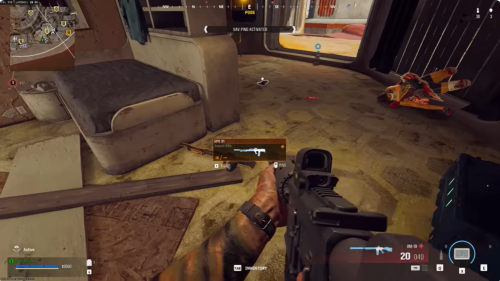
Ping the exact location. That marker on everyone's screen is worth 10 vague directions. When the fight gets messy, and everyone's yelling, that ping becomes the only reliable source of truth.
This goes double for rotations. Ping where you're moving before you move. Your squad can't support a push they didn't see coming.
You knock someone, and the instinct is to thirst for the kill. Don't.
Their teammate is already rotating to trade you. If you commit to the finish, you're giving them a free kill because your focus is on the downed player instead of the doorway.
Secure your position first. Confirm the kill only when you can do it safely. Preventing the trade is more valuable than securing the elimination.
Here's the exception: If you hear that buyback sound effect, that's your cue to push. One of their players is locked in the animation and can't shoot back. That's a 2v1 window that lasts about three seconds.
Time your aggression around these audio cues. They're more reliable than any visual information.
Re-peeking the same window is asking to get a headshot. The opponent is already pre-aimed at that exact spot.
After taking shots, rotate to a different window or angle. Force them to adjust their aim, and you'll catch them mid-reset. This single habit—never re-peeking from the same position—will extend your survival time dramatically.
Standing still makes you an easy target. Even micro-movements—small strafes, crouch spam, jump-shots—make you harder to hit.
This applies even when you think you're safe. That "safe" headglitch becomes dangerous when someone holds the angle for 10 seconds. Keep moving, keep the opponent guessing, and never give them a stationary target.
For players looking to maximize their competitive edge, tools like Warzone aimbot and radar hacks for 2026 offer advanced features that some competitors leverage—though relying on pure skill development remains the most sustainable path to improvement.
When the circle shrinks, elevation becomes everything. The team with the high ground can see rotations before they happen and has better cover options.
Prioritize securing elevated positions even if it means fighting for them early. A strong position with mediocre loot beats great loot in a valley.
Fighting full squads is chaos. Fighting isolated players is easy.
When you spot a team, look for the straggler—the player who's 20 meters behind their squad. That's your target. Get the quick knock, and suddenly it's a 4v3 before the real fight starts.
This concept extends to positioning, too. Use natural cover to funnel enemies into 1v1 scenarios. Doorways, corridors, and choke points turn a squad fight into a series of individual duels.
Pros aren't faster than you—they're just pre-aimed.
Keep your crosshair at head level, pointed at the angles where enemies are likely to appear. When someone peeks, you're already on target. That's not reaction speed; that's prediction and preparation.
Practice this in every mode. Run through buildings, expecting someone around every corner, keeping your aim centered on the doorway. This becomes automatic after a few hours, and it's the closest thing to legal wallhacks you'll find.
The worst players in the lobby are the ones full-sending every fight without intel. The best players are the ones who recognize when fighting is the wrong move.
Sometimes the play is to rotate early, secure the circle, and let other teams fight it out. Sometimes it's to hold your power position and force enemies to push into your crossfire. Knowing when to fight and when to reposition is what separates good players from great ones.
These tactics won't turn you into a pro overnight. But stack enough of them together—stim movement, UAV spam, proper re-peeks, crosshair discipline—and you'll notice the shift. Fights that used to feel like coin flips become winnable. Situations where you'd normally panic become manageable.
The skill gap in Warzone isn't about who has the better RGB keyboard. It's about who understands the game's underlying systems and exploits them consistently. That's been true since 2020, and it's still true in 2026.